Voyage Studio · Folio I · Colophon
How this folio
was made.
— The letters
The text face is Fraunces, a wonky old-style serif used here with its optical size, softness, and wonk axes turned well up — the closest a variable font gets to a worn brass matrix. Captions, placards, and marginalia are set in JetBrains Mono, letterspaced like a specimen label. Interface fittings use Switzer, self-hosted, and asked to stay out of the way.
— The paintings
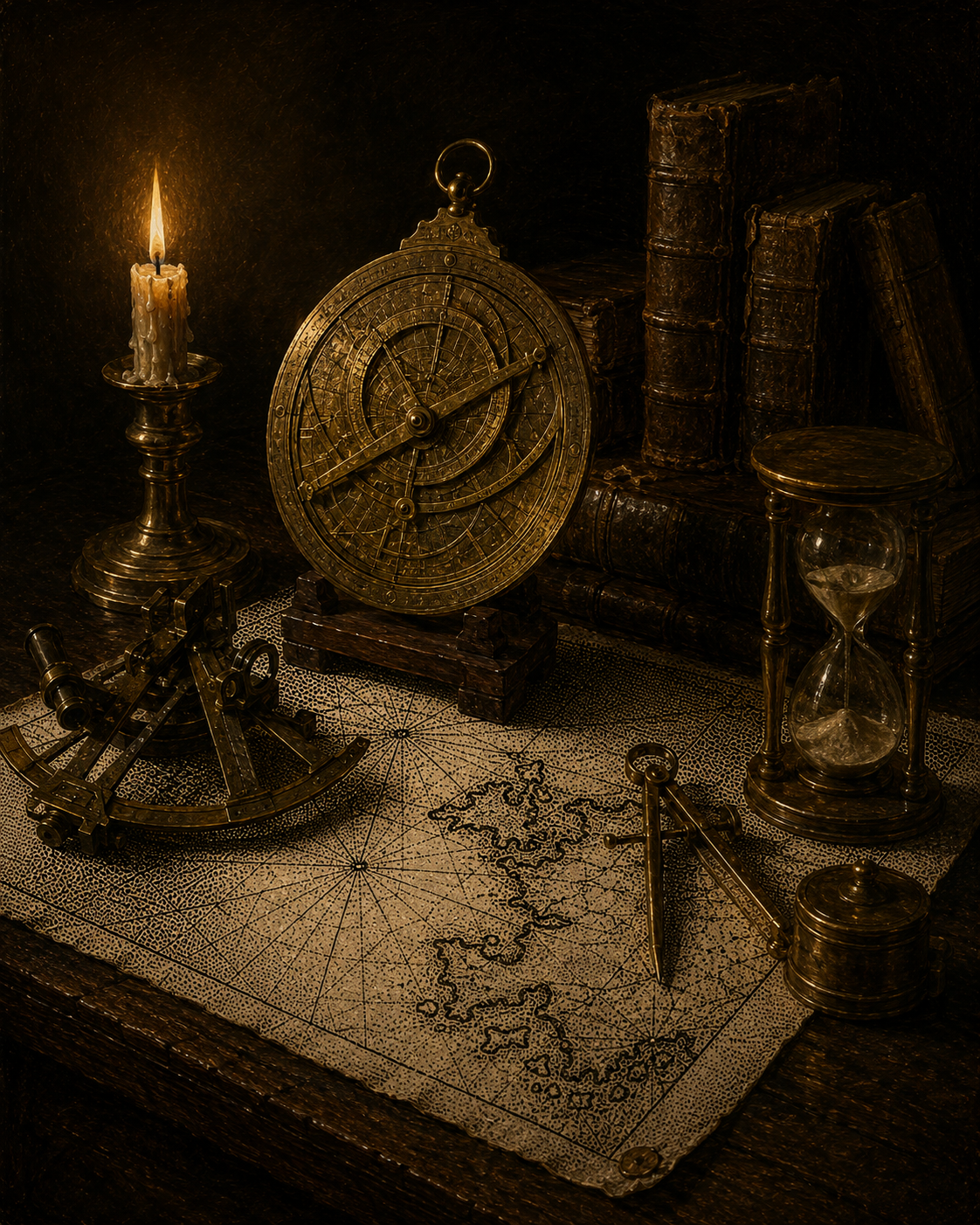
Every plate obeys one house rule: a faithful Dutch Golden Age oil painting containing exactly one impossible object, rendered in the 1-bit dither of an early Macintosh screen. Never two. The paintings are made by image models working under the studio’s direction from written commissions — sittings, the way a seventeenth-century patron would have understood them, except the painter never sleeps and the varnish is a halftone overlay. Rejected canvases outnumber hung ones considerably, which is also period-accurate.
— The machinery
The site is built with Next.js and React, typeset with Tailwind, and set in motion with Framer Motion over Lenis smooth scroll. It is served from the edge, weighs little, and carries no trackers — the only log we keep is our own. The code, like most things here, was written by the crew of agents and reviewed by the human who signs for it.
— The coordinates
N 38°42′ · W 41°06′ marks open water in the North Atlantic, between the known ports. The studio is not in a city; “studio at sea” is meant literally, as a position: in the open, under way, between the charted places.
— The impression
You are reading Folio I, second impression — the first printing with the commissioned plates in place. Earlier states of this folio exist and are not collectible.
Printed at sea · N 38°42′ · W 41°06′ · MMXXVI