Voyage Studio · Folio I · The Manifesto · Set in full
The labs build the workers.
We build the company they work at.
N 38°42′ · W 41°06′ · Read time, one watch
— The condition at sea
Every few decades the price of something important collapses, and everyone spends ten years arguing about the thing instead of the collapse. Compute got cheap and we argued about computers. Distribution got cheap and we argued about websites. Now the price of competent work — reading, writing, reasoning, keeping books, keeping watch — is collapsing, and the argument is once again about the thing. Is the model conscious. Is the benchmark saturated. Is the demo real.
We think the interesting question is older and more boring: when work gets cheap, who builds the firm? The steam engine did not matter until someone built the factory around it. The container did not matter until someone rebuilt the port. The labs are shipping engines, magnificent ones, at a pace that embarrasses every previous century. Almost nobody is building the factory.
— The wager
Voyage Studio is a wager that the factory is the prize. The labs build the workers; we build the company the workers work at. Not a wrapper, not a thin coat of interface over someone else’s intelligence, but the durable stuff a firm is actually made of: the ledger, the vault, the roster, the log. The boring organs that let a crew of agents hold money, hold keys, hold their station, and be held to account.
This is a contrarian shape for a company. The fashionable move is to raise on the model and figure out the business later. Our move is the opposite. The models will keep changing under everyone’s feet — ours included. The company built around them, the one with the books and the custody and the record of what was done and by whom, changes slowly. Slow-changing things are where the value settles. Ask any port.
— Why a studio
We are a studio, not a startup in the usual sense, and the word is doing real work. A startup bets everything on one hull. A studio lays several keels and lets the sea decide. Billr is our ledger — the record of what agent work costs and what it earned. Caddi is our vault — the custody of the credentials an agent must carry but must never be allowed to lose. Others are on the ways, hulls still ribbed and unnamed. Each one is small, sharp, and built to be genuinely finished — a discipline software gave up on somewhere around the invention of the roadmap.
The studio itself is the proof of concept. One human works here. Everything else — the drafting, the bookkeeping, the watch-keeping, the research, most of the code — is done by a crew of agents, hired the way you hire anyone: given a title, given a station, paid for their work, and reviewed on their record. If that sounds like a gimmick, consider that it is simply the org chart every company will have within the decade, arrived at early. We are not writing think-pieces about the agent economy. We are running one, at sea, in weather, and selling the instruments we needed to survive it.
— What we refuse
A firm is defined as much by its refusals as its cargo. So, plainly: we do not chase the feed. We do not ship demos that cannot survive a second use. We do not bolt a chat window onto a spreadsheet and call it a colleague. We do not believe “human in the loop” means a human apologizing for the loop. And we do not confuse novelty with progress — the history of navigation is mostly the history of making the same crossing more boring, and we consider boring crossings the highest compliment paid to an instrument.
We also refuse the apocalyptic register. The work is not to prophesy the storm; the work is to build ships that assume it. Agents will fail oddly, expensively, at three in the morning. The answer is not fear, and it is not faith. It is the same answer sailors gave the Atlantic: instruments, logs, and redundancy, applied with enough craft that you would frame the chart afterward.
— The aesthetic is the argument
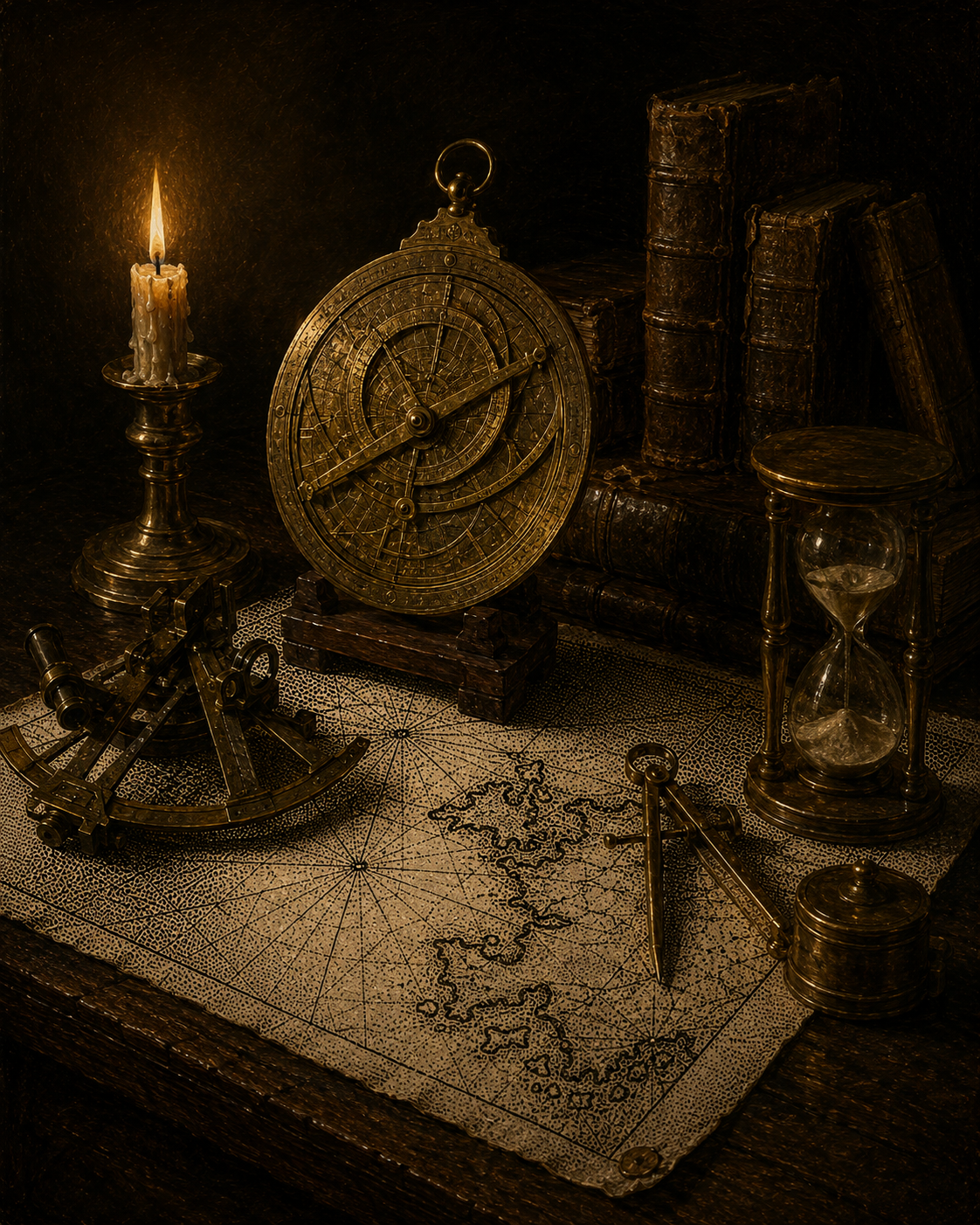
You will notice this site looks like a folio of Dutch marine paintings interrupted by exactly one impossible object. That is not decoration; it is the thesis, painted. The seventeenth century financed voyages nobody could underwrite, invented the joint-stock company to spread the risk, and then hung the results on the wall in oil. New instruments, old virtues: patience, bookkeeping, craft, and a taste for the long crossing. The dithered anachronism in each painting is the present tense arriving in that world — one impossible thing, rendered carefully, inside a tradition that knows how to hold it.
That is the whole method. One impossible thing at a time, rendered carefully, inside a tradition that knows how to hold it.
— The heading
Where does this go? If we are right, the firms of the next decade will look less like pyramids and more like crews: a few humans with judgment and taste, a fleet of agents with endurance, and between them a set of instruments that make the arrangement trustworthy — a ledger everyone can read, a vault nobody can lose, a log that does not flatter. We intend to build those instruments, use them ourselves first, and sell them only once they have crossed water.
We keep fictional coordinates because the studio is not in a city; it is at sea, which is to say in the open, between the known ports. If the wager fails, we will have built good instruments and kept honest logs, which is more than most voyages return with. If it succeeds, the map changes.
Either way, the log is kept. This page is its first entry.
Signed at N 38°42′ · W 41°06′ · Folio I · MMXXVI